| 105 new starts per model | PPO early_smooth |
Arc arc_dynamic |
Pace only clear_straight |
Pace and launch nose_guard |
|---|---|---|---|---|
| Completed laps | 88 | 93 | 93 | 95 |
| Simulator collisions | 17 | 0 | 0 | 0 |
| Timeout | 0 | 12 | 12 | 10 |
| Completed laps without raster contact | 83 | 93 | 93 | 95 |
On the 81 triples without sampled body contact, the time savings are 9.94% and 1.58%. The pace-only variant saves 9.21% against Arc and takes 0.15% longer than PPO on its own 86 completed triples.
Speed and launch clearance
On the 15 development laps both models completed, Arc traveled only 0.61% farther than PPO, but braking for the end of the visible arc capped speed in 46% of samples. The new speed head accounts for exit speed when visibility exceeds one metre. It allows more lateral acceleration on medium-radius curves and exceeds 10 m/s only on the straight arc.
The two shortest launch arcs use the actual body outline and gradually restore the 5 cm reserve. A guard for forward rays accounts for LiDAR noise and distance traveled during steering delay. Within Arc’s existing graph the edit changes 12,044 of 28,427 coefficients, including 11,906 in the envelope, 74 in the speed head and 64 in the steering head.
Two collisions motivate the revision
The first attempt recovers four of seven historical timeouts, then crashes at Austin after 0.09 s on seed 71303 from an initial clearance of 4.45 mm. The second recovers three historical cases, then crashes at Austin after 0.13 s on seed 71808 from 0.196 mm of clearance. Earlier tests become development evidence for the next revision. The final coefficients are frozen before five fresh seeds from 73101 to 73505 per track.
| Historical timeout | Initial body clearance | Final outcome |
|---|---|---|
| IMS 60404 | 28.9 mm | Clean finish in 29.08 s |
| Monza 60404 | 18.1 mm | Clean finish in 46.33 s |
| Austin 60404 | 6.3 mm | Timeout |
| Yas Marina 60404 | 9.8 mm | Timeout |
| IMS 60505 | Overlap | Timeout |
| Oschersleben 60404 and 60505 | Both overlap | Two timeouts |
The five unresolved historical timeouts include two starts with less than a centimetre of clearance and three with initial overlap. In kinematic reversing tests, over 99% of the newly swept area along feasible exits falls in the LiDAR blind sector.
Trajectory audit
The final comparison covers 420 episodes and 2,463,075 poses. On all 95 candidate finishes, the body stays clear of occupied pixels at the recorded poses. The minimum is 0.85 cm compared with Arc’s 1.69 cm. Sampling every 0.01 s excludes movement between poses and the step after the last sample. Across 315 previously observed cases, the candidate finishes 294 laps with zero reported collisions. Only the fresh 105 cases provide an independent test of this version.
Each episode lasts up to 200 simulated seconds. Finishing requires visiting at least 99% of the waypoints in order and crossing the start line without a simulator collision. Models share starting poses and LiDAR noise. Times compare laps completed from the same starts by the specified models. A negative value means a faster lap.
Completed laps by track
| Track | early_smooth |
arc_dynamic |
clear_straight |
nose_guard |
|---|---|---|---|---|
| Austin | 5/5 | 4/5 | 4/5 | 5/5 |
| BrandsHatch | 5/5 | 5/5 | 5/5 | 5/5 |
| Budapest | 5/5 | 5/5 | 5/5 | 5/5 |
| Catalunya | 5/5 | 5/5 | 5/5 | 5/5 |
| Hockenheim | 5/5 | 5/5 | 5/5 | 5/5 |
| IMS | 1/5 | 1/5 | 1/5 | 1/5 |
| Melbourne | 5/5 | 5/5 | 5/5 | 5/5 |
| MexicoCity | 5/5 | 5/5 | 5/5 | 5/5 |
| Monza | 3/5 | 4/5 | 4/5 | 4/5 |
| MoscowRaceway | 5/5 | 5/5 | 5/5 | 5/5 |
| Nuerburgring | 5/5 | 5/5 | 5/5 | 5/5 |
| Oschersleben | 3/5 | 2/5 | 2/5 | 3/5 |
| Sakhir | 4/5 | 5/5 | 5/5 | 5/5 |
| SaoPaulo | 5/5 | 5/5 | 5/5 | 5/5 |
| Sepang | 5/5 | 5/5 | 5/5 | 5/5 |
| Silverstone | 5/5 | 5/5 | 5/5 | 5/5 |
| Sochi | 0/5 | 5/5 | 5/5 | 5/5 |
| Spa | 5/5 | 5/5 | 5/5 | 5/5 |
| Spielberg | 5/5 | 5/5 | 5/5 | 5/5 |
| YasMarina | 2/5 | 2/5 | 2/5 | 2/5 |
| Zandvoort | 5/5 | 5/5 | 5/5 | 5/5 |
Two paths through Sochi
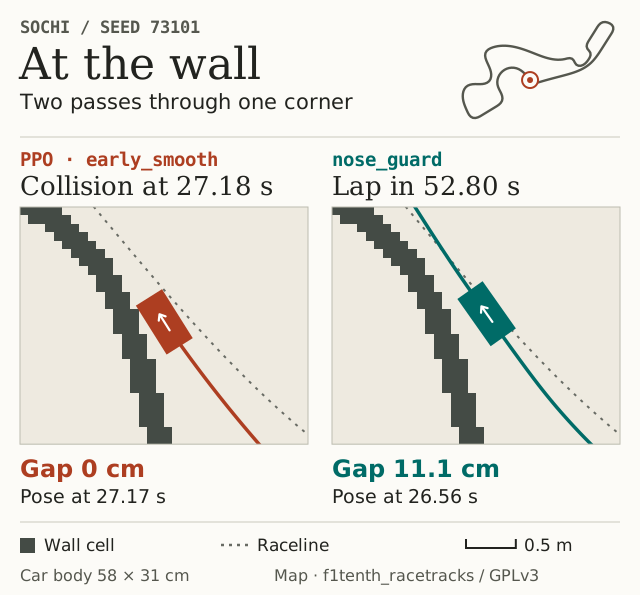
On start 73101 the edited PPO crashes after 27.18 s. Its last recorded pose is at 27.17 s. The final geometric network finishes in 52.80 s and its minimum body clearance on the raster is 2.56 cm. Both detail panels show the same section of the corner.
Data and reproduction
- Final TorchScript model
- Front guard compiler
- Frozen models and seeds
- Final four-model comparison
- Audit of the seven historical timeouts
Timeout diagnosis: follow-up with GPT-6.1 High
On 3 November 2026, a separate experiment with GPT-6.1 Sol, High reasoning, revisited the final network’s ten timeouts. This follow-up is not attributed to Astra. Full-body geometry checks (58 × 31 cm) on the archived traces reveal nine starts already overlapping occupied wall pixels. The only initially clear start, IMS seed 73404, has just 7.87 mm clearance and remains blocked: the conservative feasibility predicate selects no traversable departure.
The diagnosis does not turn failures into successes: the historical result remains 95/105, zero reported collisions and ten timeouts. The distinction between the simulator’s collision check and the full footprint explains why zero reported collisions can coexist with geometrically invalid initial poses.
We directly programmed a departure trial into the weights, using a 0.20 m arc and commands up to 0.35 m/s, with the simulator unchanged. On IMS 73404, the simulator reported a collision after 2.14 s: the candidate was rejected and did not replace the published checkpoint. This trial reuses an already observed failure and is not a new generalisation test.
As a protocol correction, a preflight script reconstructs seeded initial poses and checks the full footprint before evaluation: all 105 poses exactly match the archived traces. It identifies nine invalid starts and rejects the entire batch with exit code 2, without replacing or removing episodes. The clear-start deadlock remains unresolved; this check does not constitute a network improvement.
Experiment record and rejected result · Ten-timeout diagnosis · All 105 initial-pose checks · Preflight code · Rejected weight generator