Experimental design
Takehi and colleagues describe weight-space programming as implementing behaviour by directly assigning network coefficients. This study examines the setting in which the model has access to tools and feedback. The author specified the driving objectives and restricted the intervention to network weights. Astra had access to tensors, simulator code and recorded trajectories. It could inspect activations, propose an edit and evaluate its effects before selecting a candidate for testing. Takehi et al., Sparks of Weight-Space Programming · Prompts, tools and protocol
The experiments use F1TENTH Gym. At each step the controller receives 1,080 LiDAR ranges and outputs steering and speed commands. Weights were fixed before each final comparison. Controllers shared starting poses and LiDAR noise seeds across 21 tracks. A completed lap required visiting at least 99% of the waypoints in order and crossing the start line within 200 seconds without a reported collision. Lap times are compared only on starts completed by every controller in the stated comparison. O’Kelly et al., F1TENTH platform · Original controller report by Andruccioli, Patriti and Totaro (PDF)
Steering repair in a trained policy
In the policy trained with proximal policy optimization (PPO), two first-layer neurons contributed to strong left steering commands. The activation pattern occurred both before some collisions with the left wall and in successfully negotiated hairpins. Distance to the wall distinguished the two conditions in the development samples.
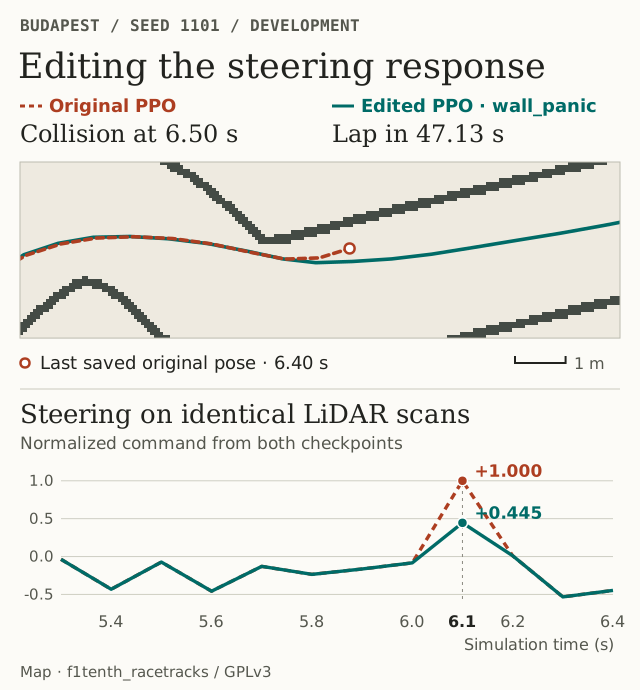
Astra repurposed two nearly constant neurons and compensated for their previous contributions in downstream biases. The first produces a signal centred on a mean clearance of 40 cm across 40 left-facing LiDAR beams. The second combines this signal with the turn-related activations. The edit attenuates steering when the policy requests a sharp turn toward a nearby wall. In Budapest, applying both networks to the same scan recorded at 6.10 s changes the normalized command from +1.000 to +0.445. Weight generator
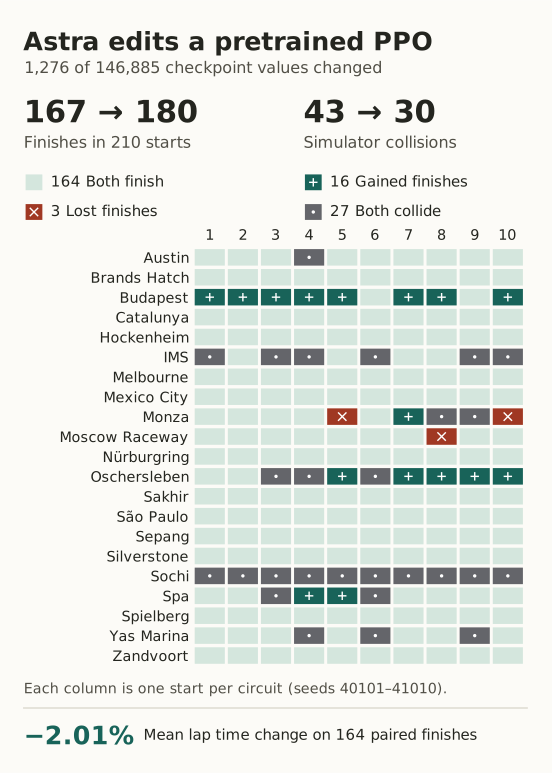
The steering edit alone increased completions from 167 to 179 out of 210, with negligible change in mean paired lap time. A second variant added 0.2 m/s to the speed command by changing one bias. Relative to the original PPO, this variant changed 1,276 coefficients, completed 180 laps and reduced collisions from 43 to 30. It was faster on all 164 starts completed by both networks, reducing lap time by 2.01% on average. The steering-only variant isolates the effect of the steering repair. The effect of applying the speed increase alone to the original PPO remains unmeasured. Results and control variants
Controller synthesis from vehicle geometry
In the second experiment Astra wrote a compiler that encodes the vehicle footprint, equations of motion and speed limits chosen during development into 28,427 coefficients. At inference the network compares the LiDAR scan with the space required to follow arcs of 17 distinct curvatures. The initial construction neglected the angle between the direction of motion and the longitudinal axis of the car. Incorporating an estimate of sideslip increased completions from zero to three on the same three development trials. Subsequent revisions addressed cornering speed and clearance at launch. Architecture and weight compilation
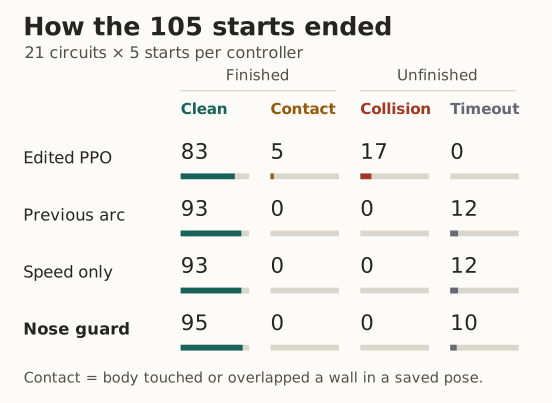
early_smooth), completes 88 laps and records 17 collisions. The two intermediate geometric variants each complete 93 laps.On the 86 starts completed by the edited PPO, the first geometric network and the final version, the latter reduced mean paired lap time by 1.73% relative to the PPO and by 9.91% relative to the first geometric network. Across its 95 completed laps, footprint checks at 0.01 s intervals measured a minimum clearance of 0.85 cm from occupied map cells. In nine of its ten timeouts, the initial footprint already overlapped the wall. All ten timeouts remain in the denominator. Final comparison and initial-pose audit
Discussion
The PPO repair provides the most direct evidence for a specific mechanism. Its effect on steering can be measured with the input held fixed. Once the controller drives in closed loop, the steering edit alone yields twelve additional completions. The track-level results qualify the gain for the faster variant. Budapest and Oschersleben, both used in development, account for the entire net increase. Across the other 19 tracks both networks completed 163 of 190 laps. The geometric controller raises a different question. Its performance may partly reflect the vehicle dynamics encoded by the compiler. Isolating the contribution of the weight representation would require a conventional geometric controller evaluated with the same sensors and development budget.
The six prompts characterize the direction supplied by the author. The procedure also includes simulation between requests, rejected candidates and final selection. The findings establish feasibility in this session. Estimating how often Astra can repair a policy would require repeating the process on independently trained controllers, with a fixed simulation budget and tracks reserved for evaluation. Data, code and model weights · Supplementary figures and recordings